Horizon Europe is the EU framework program for research and innovation (2021–2027), with a budget of more than €95 billion. It supports projects that range from basic research to industrial innovation and policy coordination, aligned with priorities such as the European Green Deal, the digital transition, and sustainable development.
The programme is organized into three pillars: I. Excellent Science (ERC, MSCA), II. Global Challenges and European Industrial Competitiveness (thematic clusters such as health, climate, or mobility), and III. Innovative Europe (EIC and EIT). Research and Innovation Actions (RIA), Innovation Actions (IA), and Coordination and Support Actions (CSA) are mainly located under Pillar II, although there are exceptional calls in other pillars or transversal missions. Choosing the correct type of action is essential for eligibility and for a good evaluation of the proposal.
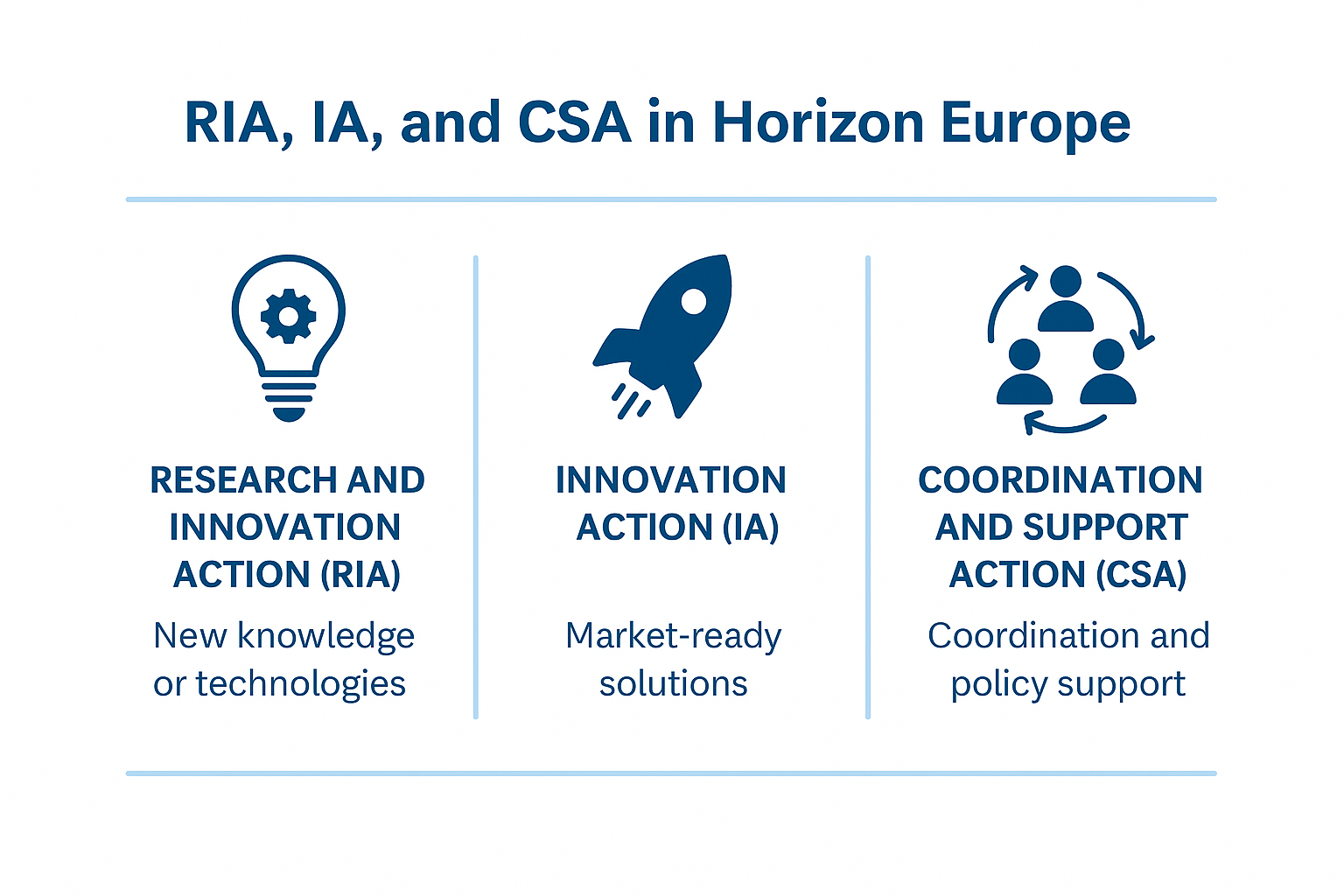
RIA supports consortia that develop new knowledge or explore the feasibility of novel technologies at low or intermediate technology readiness levels (TRL 2–5/6). Their objectives are to advance the state of the art, validate concepts, and lay the groundwork for future innovations. Typical results include publications, patents, initial software tools, and preliminary models. RIA funds up to 100 % of direct costs plus 25% indirect costs for all beneficiaries. They are usually coordinated by universities or research centers, with consortia formed by at least three entities from different Member States or associated countries.
IA focuses on solutions close to the market, at higher TRLs (approximately 5–8), with activities such as prototyping, demonstrations, validation in real environments, market replication, and preparation for certification and adoption. It aims to overcome the “valley of death” between the laboratory and commercialization. The consortium is usually led by a private entity (SMEs, technology companies, industrial players) with a direct interest in commercial exploitation, complemented by academic partners, public authorities, end users, and specialists in regulation, standardization, and communication. Non-profit entities may receive up to 100% of direct costs, while for-profit entities receive up to 70%, plus 25% indirect costs in both cases.
CSA does not fund research or technological development as such, but supports cooperation, capacity building, knowledge dissemination, and policy support. They include activities such as drafting roadmaps, developing training platforms, aligning national and European priorities, standardization, and awareness-raising campaigns. They are funded at 100% of direct costs plus 25% of indirect costs for all types of entities. They usually involve public administrations, industrial associations, civil society organizations, and, in certain cases, they may be carried out by a single beneficiary.
The choice between RIA, IA, and CSA must align with the project’s objectives: RIA for novel and exploratory concepts, IA for validation and deployment in real conditions, and CSA for coordinating existing initiatives and providing policy support. All proposals are evaluated according to three criteria: Excellence, Impact, and Implementation. The integration of robust risk management, sustainability plans beyond the end of the project, and a clear exploitation and dissemination strategy increases the chances of success across all project types.